Arborist Group

British Columbia

Tree protection barrier distances across Metro Vancouver

Where the fence goes around a retained tree, municipality by municipality, and a lookup for one tree.

Updated

Vancouver here means the City of Vancouver, BC, under Protection of Trees By-law No. 9958. It is not Vancouver, Washington, whose rules turn up in many search answers.

Metro Vancouver has no single barrier rule. Each of the 21 municipalities writes its own, and the rules fall into a few kinds: a printed table of distances, a formula that multiplies the trunk diameter, the tree's dripline, or no distance at all.

Every rule below comes from the municipality's bylaw or its own published standard. Each row names the section and the date we last checked it. Where a rule gives no number for a tree, the row says to confirm with the municipality. We do not fill that gap with a guess.

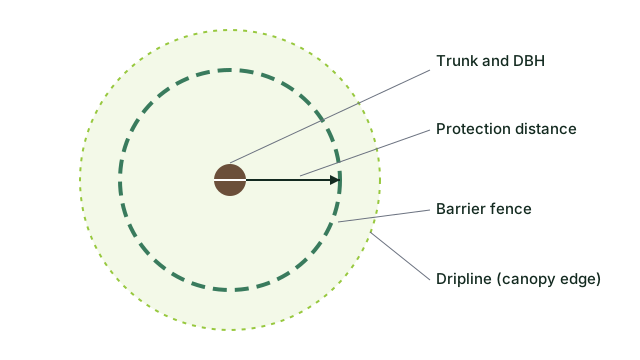
Plan view of a tree: the trunk at the centre, the DBH across the trunk, the barrier circle at the protection distance, and the dripline at the edge of the canopy.
The barrier distance is a radius, measured from the trunk. Some bylaws use the dripline when it reaches further.

Go to the lookup to check one tree.

The printed tables disagree at 90 cm

7 municipalities publish a table of distances, in a bylaw schedule, a bulletin or a standard drawing. For a trunk of 90 cm, the tables give 2 different answers.

Printed barrier distance at the example trunk diameter
MunicipalityPrinted distanceWhere it is printed
New Westminster5.0 ms.2.1(m) and Schedule B
City of North Vancouver5.4 mStandard Drawing T1-S and s.3
Port Coquitlam5.4 ms.3.1(y) and Schedule B
Richmond5.0 mFallback where the dripline cannot be usedBylaw 8057 s.5.2.4(a) and Bulletin TREE-03
Surrey5.4 mSchedule C Table 1 and s.63
Vancouver5.0 mSchedule A and s.7.5 to s.7.9
West Vancouver5.4 mSchedule A

The figure is what the municipality prints in that document. The municipality still sets the final requirement for a site, so treat a printed row as the starting point for the plan, not the approval.

Where a bylaw uses a formula instead, the usual multiplier is 6 × DBH. The District of North Vancouver is the only municipality that uses 10 × DBH.

The dripline wins where it reaches further in Delta, Maple Ridge, City of North Vancouver and Pitt Meadows. In New Westminster and White Rock, a line 1 m beyond the dripline wins where it reaches further. Burnaby and Richmond put the barrier at the dripline itself. Anmore, Belcarra, Bowen Island and Lions Bay set no barrier distance.

Municipality by municipality

Anmore

Lot coverage

Anmore sets no barrier distance. The bylaw works by lot coverage: an owner keeps or replants tree cover, measured as drip-line area ÷ lot area × 100, from 10% on smaller lots up to 75% on the largest.

At 90 cm
Confirm with the Village of Anmore
Size trigger
A permit applies to a tree 20 cm or more in diameter at 1.4 m.
DBH measured at
1.4 m
Section
s.5 to s.7

Last checked 2026-09-01. Source: primary source for Anmore.

Belcarra

No barrier rule

The Village tree bylaw covers municipal land only, and it sets no protection zone formula.

At 90 cm
Confirm with the Village of Belcarra
Size trigger
The Village tree bylaw covers municipal land only.
Section
Bylaw 589

Last checked 2026-09-01. Source: primary source for Belcarra.

Bowen Island

No barrier rule

Bowen Island has no tree removal bylaw for private property. A Development Permit can still attach tree conditions to a project.

At 90 cm
Confirm with Bowen Island Municipality
Size trigger
No tree removal bylaw for private property.
Section
FAQ: no private tree bylaw

Last checked 2026-09-01. Source: primary source for Bowen Island.

The fence goes on or outside the measured dripline and stands at least 1.2 m high. Burnaby prints no diameter table.

At 90 cm
On or outside the dripline
Size trigger
20.3 cm on a property under a development application. Otherwise 30.5 cm for a conifer and 45.7 cm for a broadleaf tree.
DBH measured at
1.3 m
Section
s.8

Last checked 2026-09-01. Source: primary source for Burnaby.

Coquitlam

Protection zone formula, no barrier distance

The City treats the dripline as the CRZ and sets a Minimum Protection Zone of six times the tree's DBH. Both definitions come from the City's Trees and Development page, not the bylaw. The page does not say where the barrier stands, so confirm the barrier distance with the City of Coquitlam.

At 90 cm
Protection zone 6 × 90 cm = 5.4 m. Barrier: confirm with the City of Coquitlam
Size trigger
20 cm at 1.4 m, or a tree 5 m or taller on a steep slope.
DBH measured at
1.4 m
Section
Trees and Development page

Last checked 2026-09-01. Source: primary source for Coquitlam.

Delta

Formula or the dripline, whichever is greater

The protective barrier must equal the extent of the drip line or six times the tree diameter, whichever is greater.

At 90 cm
6 × 90 cm = 5.4 m, or the dripline if wider
Size trigger
20 cm at 1.4 m, or the combined diameter of the 3 largest stems.
DBH measured at
1.4 m
Section
Schedule C

Last checked 2026-09-01. Source: primary source for Delta.

City of Langley

Formula

The CRZ is a circle with a radius of DBH × 6. The TPZ must at least contain the CRZ, and an arborist sizes it beyond that to the Director's satisfaction.

At 90 cm
6 × 90 cm = 5.4 m
Size trigger
75 cm anywhere for a Significant Tree, and 20 cm on a lot with a Development Application.
DBH measured at
1.4 m
Section
s.2(9) and s.2(34)

Last checked 2026-09-01. Source: primary source for City of Langley.

Township of Langley

Formula

The CRZ is a circle with a radius of DBH × 6. A barrier at least 1.2 m high is required where a CRZ is within 4 m of works. For a tree on the next lot, the barrier runs to the property line.

At 90 cm
6 × 90 cm = 5.4 m
Size trigger
20 cm at 1.4 m. Development applications run outside this bylaw (§3(h)).
DBH measured at
1.4 m
Section
§2

Last checked 2026-09-01. Source: primary source for Township of Langley.

Lions Bay

No barrier rule

The Village tree bylaw covers municipal land only. It sets no protection zone formula and no fencing spec.

At 90 cm
Confirm with the Village of Lions Bay
Size trigger
The Village tree bylaw covers municipal land only.
Section
Bylaw 393

Last checked 2026-09-01. Source: primary source for Lions Bay.

Maple Ridge

Formula or the dripline, whichever is greater

The CRZ is a circle whose radius is the greater of 6 × DBH or the tree's dripline. A barrier is required when a retained protected tree's CRZ is within 10 m of excavation, demolition, construction or servicing.

At 90 cm
6 × 90 cm = 5.4 m, or the dripline if wider
Size trigger
20 cm, or a stump over 25 cm at grade.
DBH measured at
1.40 m
Section
§3.1 and §10.1(a)

Last checked 2026-09-01. Source: primary source for Maple Ridge.

New Westminster

Printed table and formula, or the dripline if greater

The CRZ is a circle with a radius of DBH × 6, or 1 m beyond the dripline, whichever is greater. Schedule B prints a table as well, and its 90 cm row reads 5.0 m. Work within 4 m of a protected tree's dripline needs a barrier and a permit, or a CRZ work authorization (s.8.1).

At 90 cm
Printed 5.0 m. Formula 6 × 90 cm = 5.4 m
Size trigger
20 cm at 1.3 m, or 20 cm combined for the two largest trunks.
DBH measured at
1.3 m
Section
s.2.1(m) and Schedule B
Printed rows
Trunk diameter (cm)Distance (m)
201.2
754.5
905.0
1006.0

The published table we could verify has these Schedule B rows. Confirm other sizes with the City of New Westminster.

Last checked 2026-09-01. Source: primary source for New Westminster.

City of North Vancouver

Printed table or the dripline, whichever is greater

Standard Drawing T1-S sets the barrier: use the table value or the distance from the trunk face to the dripline, whichever is greater. The bylaw sets the CRZ at 6 × DBH in cm (s.3).

At 90 cm
5.4 m printed, or the dripline if wider
Size trigger
20 cm at 1.4 m. Bylaw 9143 exempts trees whose entire trunk sits on RS-1, RS-2, RS-4B, RT-1, RT-2 or GO zoned land.
DBH measured at
1.4 m
Section
Standard Drawing T1-S and s.3
Printed rows
Trunk diameter (cm)Distance (m)
under 101.2
10 to 291.8
30 to 402.4
41 to 503.0
51 to 603.6
61 to 704.2
71 to 804.8
81 to 905.4
91 to 1006.0

Last checked 2026-09-01. Source: primary source for City of North Vancouver.

District of North Vancouver

Formula

The protected area around the tree is 10 × DBH, and a certified arborist can adjust it for the site and species. The barrier sits on its outer edge with Tree Protection Zone signage, and the Environmental Protection Officer inspects it before work starts. A barrier failure is ticketable at $300.

At 90 cm
10 × 90 cm = 9.0 m
Size trigger
75 cm for a large-diameter tree. Other protected trees have no size floor, for example trees on District land, streamside trees and six named species.
DBH measured at
1.3 m
Section
Bylaw 7671

Last checked 2026-09-01. Source: primary source for District of North Vancouver.

Pitt Meadows

Formula or the dripline, whichever is greater

The CRZ is a circle with a radius of DBH × 6, or the Drip Line, whichever is greater. The Tree Protection Zone is the CRZ. The barrier construction spec is not in the bylaw.

At 90 cm
6 × 90 cm = 5.4 m, or the dripline if wider
Size trigger
20 cm, measured 140 cm above natural grade.
DBH measured at
140 cm
Section
s.3.14 and s.3.42

Last checked 2026-09-01. Source: primary source for Pitt Meadows.

Port Coquitlam

Printed table from a formula

The root protection zone is a circle with a radius of 6 × the tree's diameter, and Schedule B prints it as a table. A barrier is needed when a tree's dripline is within 4 m of excavation, demolition, construction or fill (ss.9.1 and 9.2).

At 90 cm
5.4 m printed
Size trigger
15 cm at 1.4 m, or a tree 5 m or taller.
DBH measured at
1.4 m
Section
s.3.1(y) and Schedule B
Printed rows
Trunk diameter (cm)Distance (m)
201.2
251.5
301.8
352.1
402.4
452.7
503.0
553.3
603.6
754.5
905.4
1006.0

Last checked 2026-09-01. Source: primary source for Port Coquitlam.

Port Moody

Formula

The CRZ is a circle with a radius of DBH × 6. The TPZ must at least contain the CRZ, and an arborist sizes it beyond that to the General Manager's satisfaction. A 1 m Temporary Disturbance Zone surrounds the TPZ.

At 90 cm
6 × 90 cm = 5.4 m
Size trigger
30 cm on any lot, or 10 cm for six named species and in riparian, environmentally sensitive or development areas.
DBH measured at
1.4 m
Section
Bylaw 3531

Last checked 2026-09-01. Source: primary source for Port Moody.

Richmond

Dripline first, then a printed table

The dripline comes first. Bylaw 8057 defines the tree protection barrier as a fence at least 1.2 metres high around the drip line of a retained tree. Where the dripline cannot be used, Bulletin TREE-03 prints a Tree Protection Distance Table. TREE-03 warns that failing to maintain a barrier can bring fines of up to $50,000 per offence.

At 90 cm
At the dripline. Fallback table: 5.0 m
Size trigger
20 cm at 1.4 m, and 4.5 m tall.
DBH measured at
1.4 m
Section
Bylaw 8057 s.5.2.4(a) and Bulletin TREE-03
Printed rows
Trunk diameter (cm)Distance (m)
201.2
251.5
301.8
352.1
402.4
452.7
503.0
553.3
603.6
754.5
905.0
1006.0

Last checked 2026-09-25. Source: primary source for Richmond.

Surrey

Printed table

Schedule C Table 1 prints the protection barrier radius for each listed trunk diameter. A barrier is required whenever work happens within 10 m of a protected trunk. The fence stands at least 1.2 m high.

At 90 cm
5.4 m printed
Size trigger
30 cm at 1.4 m, or a stump of 35 cm.
DBH measured at
1.4 m
Section
Schedule C Table 1 and s.63
Printed rows
Trunk diameter (cm)Distance (m)
201.2
603.6
754.5
905.4
1006.0

The published table we could verify has these Table 1 rows. Confirm other sizes with the City of Surrey.

Last checked 2026-09-01. Source: primary source for Surrey.

Vancouver

Printed table

Schedule A of By-law 9958 prints the protection barrier distance for each listed trunk diameter. The owner installs a barrier for each retention tree before demolition, excavation or construction begins (s.7.5). For a neighbour's tree within two metres of the boundary, the barrier extends into the site by the greater of two metres or the distance an arborist or the Director of Planning sets (s.7.7). The Chief Building Official must inspect and approve each barrier before a demolition, excavation or construction permit (s.7.9).

At 90 cm
5.0 m printed
Size trigger
20 cm at 1.4 m.
DBH measured at
1.4 m
Section
Schedule A and s.7.5 to s.7.9
Printed rows
Trunk diameter (cm)Distance (m)
201.2
251.5
301.8
352.1
402.4
452.7
503.0
553.3
603.6
754.5
905.0
1006.0

Last checked 2026-09-25. Source: primary source for Vancouver.

West Vancouver

Printed table

Schedule A, Protection Zone Minimum Fence Distance, prints the fence distance for each listed trunk diameter. The printed rows are irregular, so read the row for the tree's size. The fence stands 1.2 m high.

At 90 cm
5.4 m printed
Size trigger
More than 75 cm, or more than 20 cm for six named species. Bylaw 5373 adds trees of 20 cm or more on parcels under development.
DBH measured at
1.4 m
Section
Schedule A
Printed rows
Trunk diameter (cm)Distance (m)
201.2
251.5
302.1
352.4
402.7
503.0
553.3
603.6
754.5
905.4
1006.0

Last checked 2026-09-01. Source: primary source for West Vancouver.

White Rock

Formula or the dripline, whichever is greater

The CRZ and the TPZ are the same zone: a radius of DBH × 6, or 1 m beyond the dripline, whichever is greater. Schedule A sites the barrier by the same rule.

At 90 cm
6 × 90 cm = 5.4 m, or 1 m past the dripline if wider
Size trigger
20 cm at 1.4 m.
DBH measured at
1.4 m
Section
Schedule A

Last checked 2026-09-01. Source: primary source for White Rock.

Look up the barrier distance for one tree

Pick the municipality and enter the trunk diameter measured at the height that municipality sets. For a tree with several stems, enter every stem, separated by commas. The lookup combines them by the municipality's own rule and shows the legal diameter at breast height (DBH). Add the dripline radius if you have measured it, because several bylaws use the dripline when it is wider.

One number per stem, separated by commas.

This is a bylaw lookup, not a compliance determination. The municipality decides what a site needs.

The barrier plan belongs in the arborist report

Where a municipality asks for an arborist report before demolition or construction, the barrier plan belongs in that report. Our construction and development arborist reports page explains how we handle Metro Vancouver projects, and the contact page takes the site details.

We confirm availability for your address before we quote. We do not offer emergency service.

Reply Within 24 HoursSubmit below or email info@arboristgroup.com
Contact

Get a quote

Tell us about your property and an ISA Certified Arborist will follow up with next steps and a firm quote.

  • Free consultation, response within 24 hours.
  • We confirm availability for your address before we quote.
  • Independent assessment. No tree-removal sales, no conflict of interest.

Serving Metro Vancouver, British Columbia.

ISA Certified Arborist  ·  ISA Member  ·  ASCA Member

Get Your Free Consultation

Service Needed